
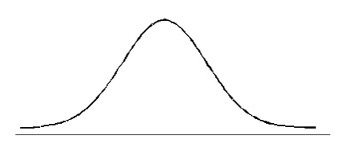
At some point in the past 10 years, I realized that this simple drawing was helpful to the understanding of most things in health and perhaps life. When you measure any characteristic in a population, for example weight and then plot it on a graph, it will be a bell-shaped curve. The peak of the curve is then what is defined as normal for a population because that is the average. Those to the right of the peak would be varying degrees of overweight and those to the left would be underweight. The average for males and females would be different but there would be significant overlap in the curves. Thus weight alone would not be a good way of determining male versus female.
There are many differences between the skeletal muscles in males and females but I want to highlight a couple for purposes of this discussion. Skeletal muscles are the ones that we have voluntary control over (the ones that make our skeletons move.} Smooth muscles make up our internal organs and we have little voluntary control over those muscles (intestinal contractions or peristalsis).
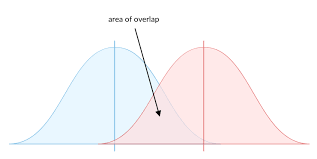
There are two types of fibers in skeletal muscles, fast twitch for quickness and power and slow twitch for endurance. Males have more fast twitch fibers and females have more slow twitch fibers. If you graph out density of fast twitch fibers of males in one graph and fast twitch fibers in females in another graph, there would be an area of overlap as below. Thus, you could not use the amount of fast twitch (or slow twitch for that matter) to determine if a number was from a biologic male or female. Females that overlap with male fast-twitch density are likely more competitive in athletics than other females.
These sex differences emerge during puberty. Individuals go through puberty at different ages – generally 11- 14. Males that go through puberty at a young age are going to have a huge competitive advantage over boys that go through later. This is on full display at a middle school track and field event. Some 8th graders look like adult males and some still look like children. Is it fair that they compete against each other in events?
Hip width is another interesting consideration. Males have narrowing hips than women. Wider hips are thought to make vaginal childbirth easier for females. But the graphs of hip width would overlap between males and females to some degree. Females with narrow hips often look like males from the back. Again this may be a big advantage in competitive sports. Fortunately, having narrow hips, does not preclude a female from having successful vaginal childbirth.
So if the primary concern regarding transfemales competing as women in sporting events is competitive advantage, then perhaps it is time we develop an index of biologic characteristics determinative for competitiveness in each sport and use the index to determine who competes with whom rather than sex alone.
If a individual born as a male but strongly identifies as female starts testosterone blockers at puberty to stop the development of male secondary sexual characteristics, the “male muscle” advantage will not develop and competing with individuals born female would be more fair than this individual being forced to compete with males.
The decision to use hormone blockers should be decision between the parents, the child and the health care team. It has nothing to do with politicians. Hormone blockers are reversible if it is not the right decision. It gives the child the best chance of living in the body they identify with. If a child must wait until they are an adult to transition then the transition is more complicated in all aspects but certainly in competitive sports. The individual who identifies as woman who goes through puberty with testosterone will have a biologic competitive index on the male spectrum than female spectrum but still be comparable to the unusual individual born as female but with the competitive characteristics of males.
So if all of the angst about transathletes is about competitive fairness, then sex should be taken out of the equation all together. There is more than enough data that can be used to determine competitive index for each sport and those that fall into certain bands on the index would compete against each other independent of what reproductive organs they have.
This is a very complicated issue that is important to a very small number of individuals around the world. As with most big cultural shifts such as increasing understanding and acceptance of sex and gender diversity, it will take time to sort out off of the downstream implications of transitioning. This should be allowed to happen and evolve as new and more information is available. It should not be a political hot potato.
Craig and I have had a lot of conversations about this, but I have never tried to write about it before.
 Tamara Unleashed